Assimilation Meaning Simple Guide For Modern Understanding
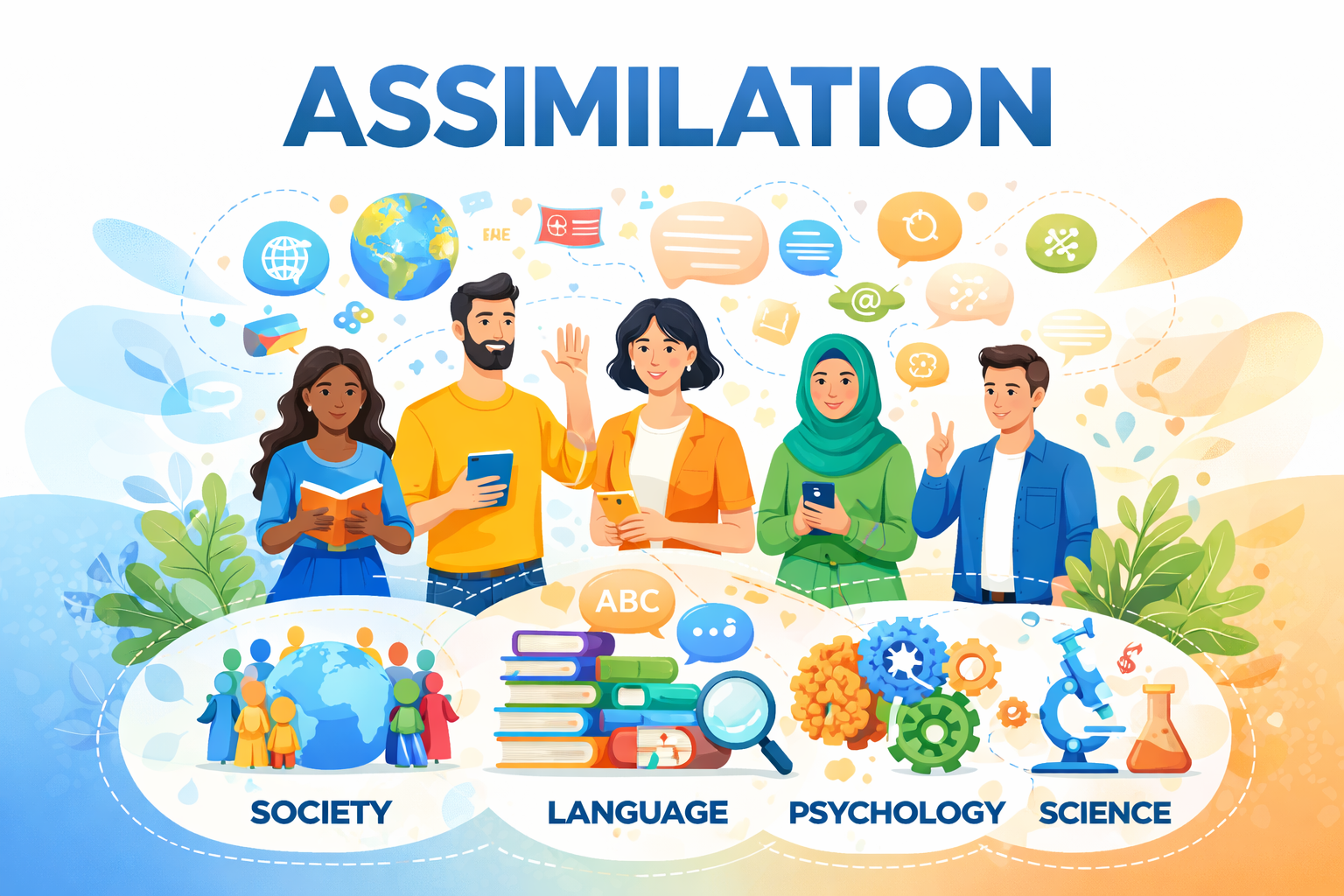
Assimilation is a common word with many meanings. It is used in society education language and science. Even though the contexts are different the idea stays the same. Assimilation means becoming similar to something that already exists.
People often hear the word assimilation in discussions about culture and migration. Students hear it in psychology and language classes. Scientists use it to explain natural processes. This article explains assimilation in a clear and simple way. It helps readers understand the word without confusion.
What is assimilation
Assimilation is a process of change. It happens slowly over time. One person group or thing adapts to match another system.
The main ideas of assimilation are:
-
change over time
-
fitting into an existing structure
-
reducing differences
-
becoming more alike
Assimilation is not a single action. It is a gradual process.
Assimilation in society
Meaning in social context
In society assimilation means that a minority group adapts to the main culture. The group changes its behavior to match social rules values and norms.
This often includes changes in:
-
language use
-
clothing style
-
traditions
-
social behavior
-
daily habits
Over time the original culture may become less visible.
How assimilation happens in society
Assimilation can happen in different ways.
Common ways include:
-
learning the dominant language
-
following social rules
-
changing public behavior
-
adapting to workplace culture
These changes help people function in society but they may also reduce cultural diversity.
Voluntary assimilation
Voluntary assimilation happens when people choose to adapt. They decide to change for practical reasons.
Common reasons include:
-
better communication
-
more job opportunities
-
social acceptance
-
personal comfort
This type of assimilation is often seen as useful and flexible.
Forced assimilation
Forced assimilation happens when people have no choice. Rules laws or pressure force change.
This may include:
-
language restrictions
-
education systems
-
legal requirements
-
social exclusion
Forced assimilation can cause stress loss of identity and conflict.
Assimilation in language
Meaning in linguistics
In linguistics assimilation describes how speech sounds change. One sound becomes more like a nearby sound. This helps make speech easier.
Speakers usually do not notice this change. It happens naturally.
Common features of sound assimilation
Sound assimilation often:
-
occurs in fast speech
-
reduces effort in speaking
-
follows mouth movement
-
becomes common over time
It is a normal part of spoken language.
Examples of sound assimilation
Common examples include:
-
hand bag spoken as hambag
-
ten bikes spoken as tem bikes
-
bank spoken as bangk
These changes improve speech flow.
Importance for language development
Assimilation supports language growth.
It helps with:
-
smoother pronunciation
-
sound consistency
-
dialect formation
-
long term language change
Many sound changes begin as assimilation.
Assimilation in psychology
Meaning in learning
In psychology assimilation explains how people learn. It describes how new information fits into existing knowledge.
The idea comes from Jean Piaget.
Mental schemas
Schemas are mental structures. They organize information.
Examples include:
-
animals
-
objects
-
people
-
actions
-
places
Schemas help the brain understand the world quickly.
How assimilation works in the mind
When new information appears the mind tries to match it to existing schemas.
This process includes:
-
focusing on similarities
-
using past experience
-
keeping current understanding
Assimilation makes learning fast and stable.
Benefits of assimilation in learning
Assimilation helps by:
-
speeding up understanding
-
reducing confusion
-
supporting memory
-
building confidence
It is essential for early learning.
Limits of assimilation
Assimilation alone is not enough.
Problems can include:
-
misunderstanding new ideas
-
ignoring important differences
-
slow personal growth
Learning improves when people adjust their thinking when needed.
Assimilation in science
Biology
In biology assimilation describes how the body uses nutrients.
This includes:
-
absorbing food
-
converting nutrients
-
building tissues
This process supports growth and health.
Geology
In geology assimilation describes material mixing.
Examples include:
-
rock material entering magma
-
chemical changes over time
-
structure transformation
This process happens slowly.
Fields using the term assimilation
| Field | Meaning |
|---|---|
| Society | Cultural adaptation |
| Language | Sound change |
| Psychology | Learning process |
| Biology | Nutrient use |
| Geology | Material mixing |
This shows how widely the term is used.
Related ideas
Assimilation is often mentioned with other terms.
Related ideas include:
-
integration
-
inclusion
-
segregation
-
marginalization
-
accommodation
Each term has a different meaning and goal.
Why understanding assimilation matters
Understanding assimilation helps people:
-
discuss culture clearly
-
design fair policies
-
support education
-
avoid misunderstanding
Clear meaning leads to better communication.
Readers who want trusted educational guides can explore more on Trucofax.
Assimilation in modern life
Assimilation is still relevant today. It appears in many areas.
These include:
-
migration discussions
-
education systems
-
workplace culture
-
language learning
The main question is balance. How much adaptation is needed and who should adapt.
Conclusion
Assimilation is a key concept across many fields. It describes how people ideas or materials become more similar to an existing system. The core meaning stays the same even when the context changes.
In society assimilation affects identity and culture. In language it shapes speech. In psychology it supports learning. In science it explains natural processes.
Assimilation is neither good nor bad by itself. Its impact depends on how and why it happens. Understanding assimilation helps create informed discussions fair systems and better learning.
For learning across many subjects readers can visit Your Topics Multiple Stories.