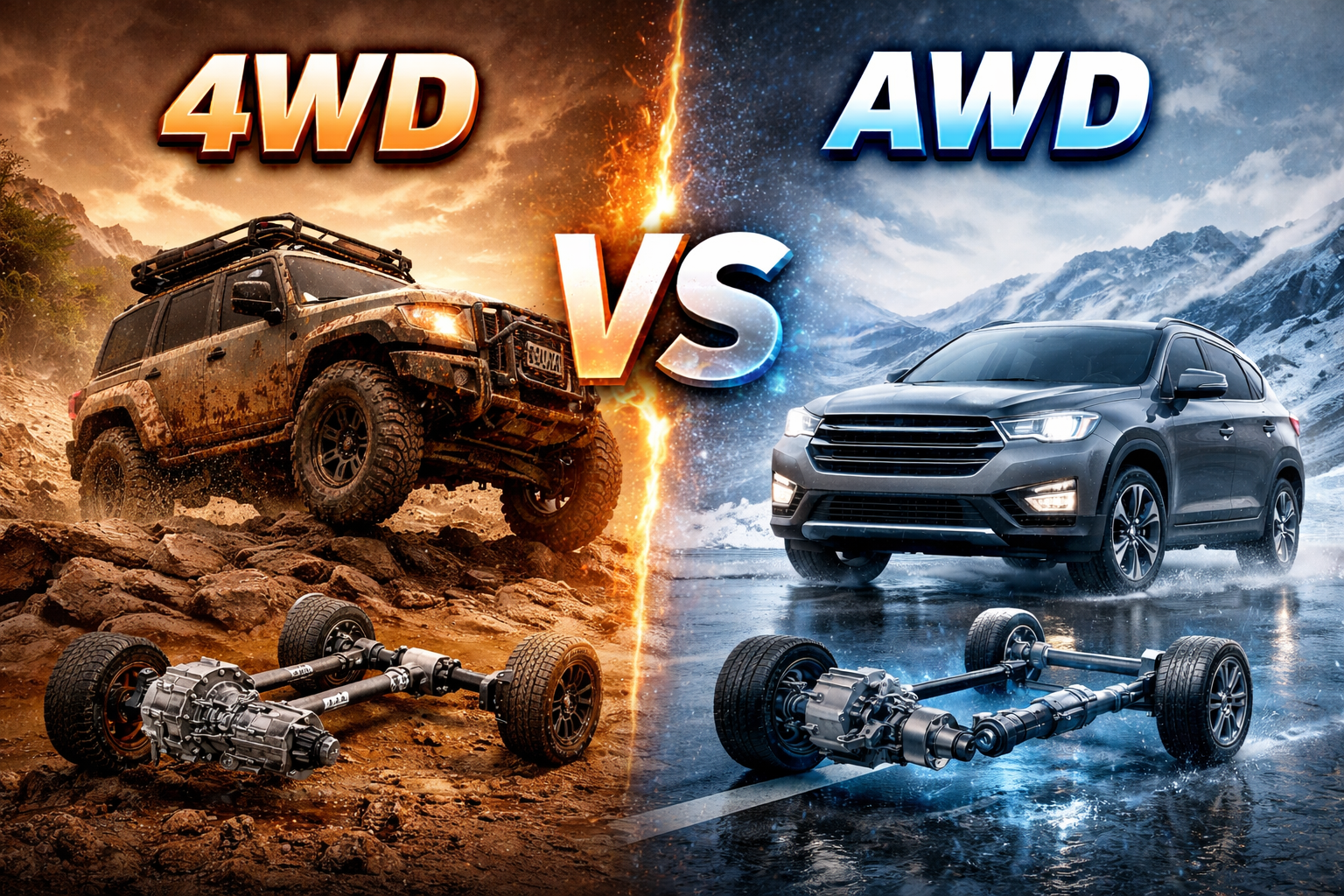
4WD vs AWD difference explained clearly: AWD powers all four wheels automatically for better road traction in rain and snow. 4WD powers all four wheels through a selectable system designed for deep off-road conditions. The difference lies in engineering design, torque control, terrain focus, and mechanical strength.
Table of Contents
ToggleAll-Wheel Drive (AWD) is a drivetrain system that sends power to both front and rear axles at the same time or when needed. Most AWD systems are computer-controlled. Sensors monitor wheel speed, throttle input, steering angle, and road grip. The system adjusts torque distribution automatically.
Manufacturers such as Subaru and Audi use full-time AWD systems that operate continuously. Many crossovers from Toyota and Honda use on-demand AWD systems.
Four-Wheel Drive (4WD), also called 4×4, uses a transfer case to connect the front and rear axles. Most 4WD systems allow manual selection between driving modes:
2H (two-wheel drive high range)
4H (four-wheel drive high range)
4L (four-wheel drive low range)
Low range increases torque through gear reduction. Vehicles such as the Jeep Wrangler and Ford Motor Company Bronco are built with strong 4WD systems for rugged terrain.
AWD systems include:
Front differential
Rear differential
Center differential or electronic clutch
Driveshaft
Traction control module
Torque split can vary from 100% front to 50:50 or rear bias depending on grip. Some systems use torque vectoring, which sends power to individual wheels for improved stability.
4WD systems include:
Transfer case
Reduction gears for low range
Front and rear driveshafts
Locking differentials in advanced models
When 4H or 4L is selected, power is delivered evenly to both axles. Low range increases torque while reducing wheel speed, which improves control on steep or rocky surfaces.
| Feature | AWD | 4WD |
|---|---|---|
| Engagement | Automatic | Manual or Electronic Selection |
| Low-Range Gear | No | Yes |
| Best Terrain | Rain, light snow | Mud, sand, rocks |
| Fuel Efficiency | Moderate | Lower |
| Drivetrain Weight | Lighter | Heavier |
| Off-Road Capability | Moderate | High |
| Daily Driving Comfort | High | Moderate |
AWD improves traction during light and moderate snowfall. The system reacts instantly to wheel slip. Vehicles from Volvo integrate AWD with stability control for winter safety.
4WD performs better in deep snow. High ground clearance and low range allow vehicles to move through heavy accumulation. However, braking distance depends on tire grip rather than drivetrain type.
AWD improves acceleration and cornering stability on wet roads. Torque shifts quickly to wheels with more grip.
4WD provides no major advantage on wet highways when in normal driving mode.
4WD excels in extreme off-road environments. Low range provides controlled torque delivery. Locking differentials prevent wheel spin when traction is uneven. Drivers who frequently explore trails and outdoor terrain can also review our Moped & ATV Adventure Guide for recreational off-road insights.
AWD manages light trails and gravel roads but lacks the gear reduction required for rock crawling.
AWD systems add weight and mechanical complexity compared to two-wheel drive vehicles. The increase in fuel consumption is usually small but measurable.
4WD systems add more weight because of transfer cases and stronger axles. Fuel efficiency drops further compared to AWD models.
Testing data from the United States Environmental Protection Agency shows AWD and 4WD models typically record lower MPG than their two-wheel-drive equivalents.
Differential fluid service
Tire rotation and matching tire sizes
Sensor and clutch inspection
Uneven tire wear can affect torque balance.
Transfer case fluid replacement
Inspection of locking hubs
Increased wear during heavy off-road use
Heavy terrain driving increases mechanical stress.
Automatic operation
Smooth daily driving
Better stability in bad weather
Improved highway handling
No low-range gearing
Limited extreme off-road ability
Low-range torque multiplication
Strong off-road durability
Better performance in deep mud and sand
Higher fuel consumption
Heavier drivetrain
Requires driver selection
Many electric vehicles use dual-motor setups to create electronic AWD. One motor powers the front axle and another powers the rear axle. This setup allows instant torque distribution without mechanical transfer cases.
Brands like Tesla use dual-motor systems to provide advanced traction and stability.
Choose AWD if:
Driving mostly on paved roads
Facing seasonal snow or heavy rain
Prioritizing comfort and efficiency
Choose 4WD if:
Driving on rocky or muddy trails
Living in rural areas with rough terrain
Towing heavy loads on uneven surfaces
Driving environment determines system necessity.
Safety depends on road conditions and tires. AWD improves traction in daily driving. 4WD improves traction in extreme terrain.
Part-time 4WD can cause drivetrain binding on dry roads.
Vehicles with AWD often have higher resale value in snowy regions.
4L multiplies torque through gear reduction for slow, controlled movement.
AWD requires no driver input and is easier for daily use.
4WD and AWD serve different engineering purposes. AWD focuses on automatic traction and daily road stability. 4WD focuses on mechanical strength and extreme terrain performance. Terrain type, weather exposure, towing needs, and fuel cost influence the correct choice. Understanding the structural and functional differences ensures informed vehicle selection.

Julia Betten Court is a faith-driven writer with a heart for inspiring others through words. She shares devotionals, ministry ideas, and creative resources that encourage spiritual growth and meaningful connection. With a focus on uplifting and practical content, Julia writes to inspire women to embrace their faith, live with purpose, and serve their communities with grace. Her work reflects a deep love for God, creativity, and the power of encouragement.
Julia Betten Court is a faith-driven writer with a heart for inspiring others through words. She shares devotionals, ministry ideas, and creative resources that encourage spiritual growth and meaningful connection. With a focus on uplifting and practical content, Julia writes to inspire women to embrace their faith, live with purpose, and serve their communities with grace. Her work reflects a deep love for God, creativity, and the power of encouragement.