Racing Thoughts at Night? 5 Ways to Actually “Disconnect” Before Bed
For the last three hours of your workday, you dreamed about your pillow. You were almost falling asleep on the couch watching Youtube.
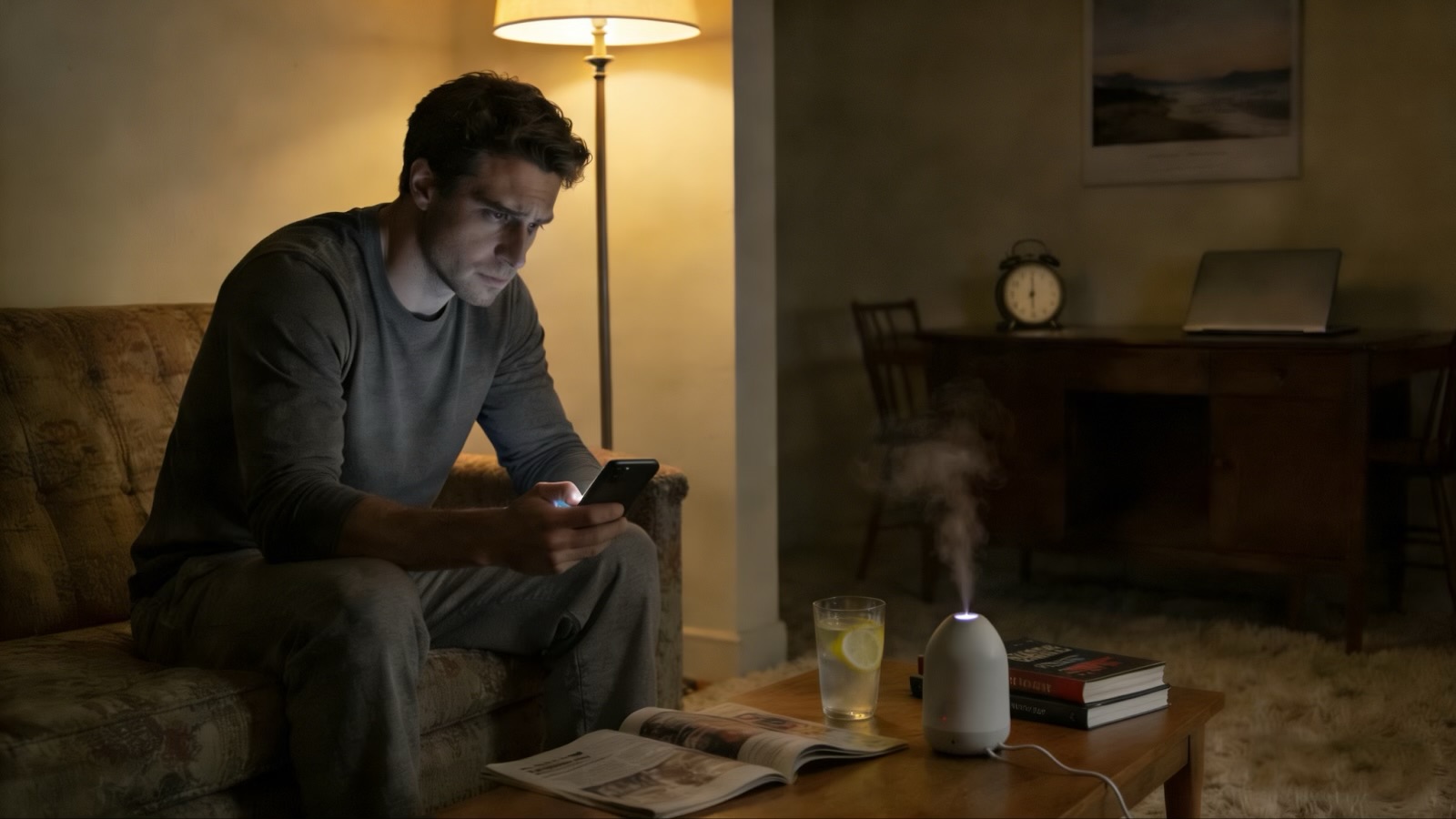
But the second you brush your teeth and get under the covers, your brain wakes up. It feels like you just drank three shots of espresso. It asks: “Hey, are you sure you locked the front door? Also, let’s plan your entire career for the next five years right now.”
It feels like a mean joke. But there is a biological name for this: Conditioned Arousal.
Your brain has accidentally learned a bad habit. It thinks your bed is a place for thinking, scrolling on your phone, and worrying. It does not think the bed is for sleeping anymore. Your mattress has become a trigger to wake up.
You are not alone. The American Academy of Sleep Medicine says that about 30% to 35% of adults have this problem. It happens because they cannot switch from “doing things” to just “resting.”
The good news? If your brain learned to be awake in bed, it can unlearn it. You don’t need to try harder to sleep (that never works). You need to use special tricks to break the habit and actually disconnect.
Why Your Brain Won’t Stop
To fix the racing thoughts, we need to look at what is happening inside your head. When you lie down and turn off the lights, your brain should rest. But for many people, a specific part of the brain turns on instead. It is called the Default Mode Network (DMN).
The “Browser Tab” Analogy
Think of this network like a web browser on your computer.
During the day, you are clicking buttons and getting work done.
When you lie down to sleep, you aren’t closing the browser. You are just minimizing the window.
The DMN is like having 50 tabs open in the background—unpaid bills, that awkward email, tomorrow’s meeting. They are still using up your battery and making the fan spin loudly, even though you aren’t “doing” anything.
Blue Light and Stress
This mental noise is often kept alive by your environment. The blue light from phones and LED bulbs hits special cells in your eyes. This signals your brain that it is noon, not midnight.
Your body stops making melatonin (the sleep hormone) and keeps making cortisol (the stress hormone). This keeps those “background tabs” open and causes anxiety at 2:00 AM.
What the Science Says
we look at the data. New studies show that specific mental tricks work better than just trying to relax.
Study A: The “Reverse Psychology” Effect (University of Glasgow)
If you can’t stop thinking, you should try to stay awake. A big study looked at people with insomnia. They tested a method called Paradoxical Intention. This is when you lie in bed and quietly try to keep your eyes open.
The Result: The group that tried to stay awake fell asleep much faster.
Why: When you stop “trying” to sleep, you stop the performance anxiety. You stop fighting yourself, so your body relaxes.
Study B: Light Goes Straight to Fear (NIH)
We know blue light wakes you up. But new research shows it also makes you anxious.
Researchers found a direct path from the eye to the Amygdala. This is the brain’s “fear center.”
The Meaning: Looking at cold, bright screens doesn’t just block sleep hormones. It actively hits the “panic button” in your brain. This is why your late-night thoughts often Sleep support glasses feel scary instead of logical. Wearing glasses is like putting sunglasses on your fear center.
The Protocol: How to Use the “Brakes”
To stop the racing thoughts, we need to use the “brakes” of your nervous system. Here are 5 steps.
1. The “Physiological Sigh” (The Body Hack)
When your mind is racing, your brain is too alert. You need to breathe in a special way to calm down.
The Trick: Take a deep breath in through your nose. Then, take one more tiny breath in at the top. Finally, breathe out long and slow through your mouth.
Why it works: This tells your heart to slow down immediately. Do this 10 times.
2. The “Mental Shelf” (Visualization)
You cannot “empty your mind.” Instead, give your thoughts a place to sit.
The Method: Imagine a fireplace with a shelf above it. When a worry pops up (“I forgot to email Dave”), imagine holding that thought like a heavy stone.
The Action: Mentally put the stone on the shelf. Tell yourself: “I am putting this here. It will be right here when I wake up. It is safe.”
Why it works: You aren’t fighting the thought. You are just saving it for later.
3. Paradoxical Intention (The Mind Hack)
If your thoughts are really fast, stop trying to sleep.
The Instruction: Lie in bed with the lights off. Keep your eyes open. Tell yourself: “I am just going to rest my body, but I will try to stay awake to watch my thoughts.”
The Result: As soon as you stop fighting, the adrenaline goes away. The “threat” is gone, and you will likely fall asleep by accident.
4. Thermal Dumping (The Temperature Hack)
A “hot head” is a real thing. Thinking hard sends blood to your head, making it warm.
The Trick: Keep your room cool (65°F), but wear warm socks.
Why it works: This pulls the hot blood from your head down to your feet to cool you off. Lowering your body temperature is a major signal to your brain that it is time to sleep.
5. The “Sunset” Ritual
You need to break the link between light and anxiety.
The Action: Put on Sleep support glasses 90 minutes before bed.
The Logic: Remember the study about fear? By blocking the blue light, you stop stimulating the anxiety center of your brain. You are making the world look dim. This makes your racing thoughts feel less scary and urgent.
Conclusion
“The best bridge between despair and hope is a good night’s sleep.” — Dr. Matthew Walker, Neuroscientist & Author of Why We Sleep
Learning how to stop racing thoughts isn’t about winning a debate with yourself. It is about realizing you don’t need to show up to the argument.
We often treat sleep like a chore—something we have to work hard at. But a racing mind loves effort. True rest is the opposite of effort; it is about surrendering. It is about making your nervous system feel safe enough to let go.
You don’t need to force your brain to shut down. You just need to stop feeding it the light and the stress that keep it running. The goal isn’t an empty mind; it is a peaceful one.
Citation
- Li, Z., Lee, C. S., Chen, S., He, B., Chen, X., Peng, H. Y., Lin, T. B., Hsieh, M. C., Lai, C. Y., & Chou, D. (2023). Blue light at night produces stress-evoked heightened aggression by enhancing brain-derived neurotrophic factor in the basolateral amygdala. Neurobiology of stress, 28, 100600. https://doi.org/10.1016/j.ynstr.2023.100600
- American Academy of Sleep Medicine, International Classification of Sleep Disorders. Diagnostic and Coding Manual, second ed., American Academy of Sleep Medicine, Westchester, IL, 2005.
- D.O. Fogle, J.A. Dyall, Paradoxical giving up and the reduction of sleep performance anxiety in chronic insomniacs, Psychother. Theory Res. Pract. 20 (1983) 21–30